|
 |
|
Weekly win for Nasdaq |
| Betting the worst was over in select techs, rally
lifts Nasdaq and Dow |
By Staff Writer Catherine
Tymkiw
March 23, 2001: 4:38 p.m.
ET
|
|
NEW YORK (CNNfn) - Strength in
U.S. technology stocks helped the Nasdaq composite index
break a seven-week losing streak Friday as traders bet
an extended sell-off had taken these issues down to
reasonable levels.
The tech-heavy Nasdaq has been
down more than 20 percent -- the conventional definition
of a bear market -- since early September.
The
Nasdaq composite index rose 30.98 to 1,928.68 and is up
2 percent this week. The Nasdaq hasn't recorded a gain
on the week since the week ended Jan. 26, when it carved
out a 0.3 percent rise. The index is still nearly 62
percent down from its high of 5,048, reached on March
10, 2000  . .
The buying
comes one day after blue-chip issues dove into bear
market territory and then rebounded out of it.
"I
think yesterday (Thursday) was as close to a
capitulation as I've seen, where all stocks were dumped
out and the momentum carried the market lower and lower
all day in the areas that had held up the best," said
Joe Battipaglia, chief investment strategist with
Gruntal & Co. "Meanwhile, the Nasdaq, which has been
crucified, showed great resilience all
day."
While the S&P 500 and the Dow
industrials fell on the week, both indexes carved out
significant gains on the day, with financial stocks
boosting the Dow.
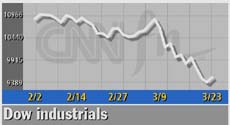
The Dow Jones industrial
average gained 115.30 to 9,504.78, ending the week down
3.2 percent, while the S&P 500 advanced 22.25 to
1,139.83, off 0.9 percent on the week. The Dow is down
18.9 percent from its Jan. 14, 2000 high of 11,722,
while the S&P is off 25 percent from its March 23,
2000 high of 1,527.
 Uncertainty about corporate profitability in a
slow economy was still underpinning the strength and
bringing out sellers in some industrial issues -- the
same sentiment that sent the Dow plunging
Thursday. Uncertainty about corporate profitability in a
slow economy was still underpinning the strength and
bringing out sellers in some industrial issues -- the
same sentiment that sent the Dow plunging
Thursday.
But analysts remained optimistic that
the day's action signaled some turnaround.
"When
the Dow was doing its swan song yesterday (Thursday),
the money was staying in the market and rotating into
tech," said Art Hogan, chief market analyst with
Jefferies & Co. "That's the first time that's
happened this year and that's good news -- folks are
changing their minds about the sectors but they're
staying in the market."
Analysts said most of the
buying and volatility was a combination of short
covering, rotating assets and no one wanting to hold
large positions ahead of the weekend.
A short
position is having an excess of sales over purchases. So
short covering would bring out buyers looking to cover
the sales.
"This is emotion moving the market,
it's not just fundamentals moving the market," said Mark
Donohoe, institutional equity sales trader with U.S.
Bancorp Piper Jaffray. "It's Friday, and you've seen the
wild swings over the past couple days."
Analysts
were still treading lightly on the significance of the
gains. They say volume, although above normal, must be
much greater to signal any real
turnaround.
Market breadth was positive. Winners
beat losers on the Nasdaq 2,485 to 1,219 as more than
2.27 billion shares were traded. On the New York Stock
Exchange advancers topped decliners 1,982 to 1,043 as
more than 1.36 billion shares changed hands.
In
other markets, Treasury
securities edged lower. The dollar fell against the
euro and yen after posting strong gains this
week.
Techs glow on Wall
Street
One day after the bears
drove the Dow sharply lower amid concern about corporate
profitability for "old economy" issues, tech stocks
started to look more attractive.
But analysts
caution that the rebound in tech issues is not reason
enough to break out the champagne.
Gruntal's
Battipaglia said the churning was a sign of the markets
finding some footing, but that it would still take some
time for investor confidence to return.
"That
doesn't happen overnight -- it's a process," he said.
"As economic data shows restoration of growth and the
stock market continues its recovery and the Fed keeps
cutting interest rates, these confidence statistics will
keep mounting."
 Intel
(INTC:
Research,
Estimates)
advanced 13 cents to $28.81 after Craig Barrett, chief
executive of the top U.S. chipmaker, said
late Thursday that his firm's outlook for next three
months was not bright. Intel
(INTC:
Research,
Estimates)
advanced 13 cents to $28.81 after Craig Barrett, chief
executive of the top U.S. chipmaker, said
late Thursday that his firm's outlook for next three
months was not bright.
The broader tech market
gained strength. Microsoft
(MSFT:
Research,
Estimates)
rose $2.56 to $56.56, IBM
(IBM:
Research,
Estimates)
surged $4.58 to $93.68, and Dell
Computer (DELL:
Research,
Estimates)
advanced $1.19 to $27.44.
But some tech issues
faltered. Cisco
Systems (CSCO:
Research,
Estimates)
shed $1 to $18.75 and JDS
Uniphase (JDSU:
Research,
Estimates)
fell $2.25 to $23.19.
Interest rate-sensitive
financial stocks on the Dow gave the blue chip index
strength. American
Express (AXP:
Research,
Estimates)
gained $2.10 to $36.80 and J.P.
Morgan (JPM:
Research,
Estimates)
rose $2.80 to $41.71. 
Industrial
and cyclical issues were mixed on the Dow, as concerns
that these companies may suffer some deceleration of
revenue growth in a slowing economy generated some
caution.
Procter
& Gamble (PG:
Research,
Estimates)
fell $2.55 to $60.20 while General
Electric (GE:
Research,
Estimates)
gained $2.29 to $39.99.
And the day's second-most
active stock, Immunex
(IMNX:
Research,
Estimates)
tumbled $7.38 to $11.50 after it said it is withdrawing
its Enbrel drug from trials as a treatment for chronic
heart failure because of indications it cannot be
effective. 
|
|
|
| | |



 click here for a printer friendly version
 click here to email this story to a friend



 Top
Stories
Top
Stories